
Date:
Location:
Title:
Interfacial Fracture in Soft Polymer Networks: Revisiting Gent's Picture
Soft polymer networks enable advances in wearable electronics, soft robotics, and flexible displays, yet their interfacial fracture remains difficult to predict. A central challenge is disentangling viscoelastic dissipation from molecular-scale damage in the energy dissipated ahead of a crack. In this seminar, I will consider this problem using polymer networks labeled with fluorogenic mechanophores. By conducting peel tests over a broad range of rates and temperatures, and by directly mapping force-induced molecular damage, I will establish a quantitative connection between viscoelasticity, damage, and adhesion energy. My results will challenge key assumptions in linear viscoelastic fracture theories, built on seminal insights from Alan Gent. More broadly, they will illustrate the molecular and mesoscale mechanisms that govern interfacial fracture, providing foundational knowledge for refining damage models and predicting failure under arbitrary, complex loads.
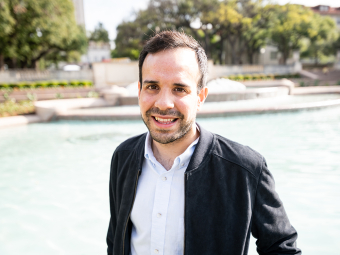
Bio: Prof. Sanoja holds a B.S. in Chemical Engineering from MIT and a Ph.D. from UC Berkeley. Throughout his studies, his research focused on the self-assembly of protein-polymer block copolymers, and the molecular design of polymeric ionic liquids. Prof. Sanoja was then a post-doctoral scholar at ESPCI Paris, where he used polymer mechanochemistry to investigate the role of polymer chain scission on mechanical durability and fracture toughness. With a background in STEM, Prof. Sanoja’s research interest lies at the interface of soft matter and polymer physics, with a focus on using advanced polymerizations and mechanochemistry for engineering the mechanical properties of polymeric materials. Originally from Caracas, Venezuela, he enjoys both intellectual pursuits and everyday pleasure, reflecting his passion for both science and humanity's well-being.